
How tourism boards are using virtual tours to inspire and convert travelers
- Web experiences
- Virtual reality
- 360° Photography
- 360° Video
Tourism boards across Europe are using virtual tours to inspire international travelers, reduce booking friction, and prove ROI. Here is what the data says and what the best destinations are doing differently.

The question that determines every booking
Every year, tourism boards compete for the same finite pool of international travelers. They invest in billboard campaigns, influencer partnerships, and glossy brochures. And yet, the question that determines whether someone actually books a trip has always been the same: can I picture myself there?
Static images and copywriting can only do so much. What actually triggers a booking decision is an emotional response — a felt sense of what it would be like to stand in that place. Virtual tours have emerged as the most powerful tool destination marketing organizations have ever had to generate exactly that response. Not as a replacement for travel, but as the thing that makes people want to travel in the first place.
The shift from inspiration to immersion
For decades, destination marketing meant broadcasting beautiful imagery and hoping it resonated. The limitation was always that inspiration is passive. Someone could admire a photo of your coastline, your mountain village, or your historic city center and still choose somewhere else simply because another destination made them feel more certain.
The virtual tour changes that dynamic entirely. Instead of showing a destination, it lets people explore it. They navigate the streets at their own pace, look up at the architecture, peer into the harbor, move between neighborhoods. The emotional investment that used to require a brochure and a leap of faith now happens in the living room, before any booking decision is made.
The global virtual tourism market was valued at USD 8.05 billion in 2024 and is projected to reach USD 30.54 billion by 2030, growing at a CAGR of nearly 25% annually. Tourism and hospitality is the fastest-growing segment driving that number. These are not just technology statistics. They reflect a fundamental shift in how travelers research and select destinations.
What high-stakes use looks like: Avoriaz
Avoriaz, a car-free ski resort in the French Alps widely considered one of Europe's top three ski domains for digital marketing, worked with Poppr to build a comprehensive 360° virtual tour. The impact exceeded every internal benchmark.
The tour solved a specific communication problem: Avoriaz is genuinely hard to explain through photos alone. Visitors consistently asked the same questions. Where do you park? How does arrival work? How close is everything to the slopes? The virtual tour answered all of those questions before they were even asked, reducing uncertainty and friction simultaneously.
When Avoriaz introduced an interactive element — the Avoriaz Quest, a seasonal treasure hunt embedded inside the virtual tour — the numbers became extraordinary. The campaign brought in approximately 43,000 new visitors and generated more than 7,000 email sign-ups, against an internal target of 1,000. Average session time more than doubled.
The virtual tour is now embedded across the entire Avoriaz digital ecosystem: on accommodation pages, parking information, arrival guides, and inside the tourist office on tablets. The Digital Marketing Manager of Avoriaz describes it as a functional tool, not a decorative one. It answers questions, reduces support calls, and improves the visitor journey at every stage.
You can read the full Avoriaz case study here: Why every ski resort needs a virtual tour: the Avoriaz story
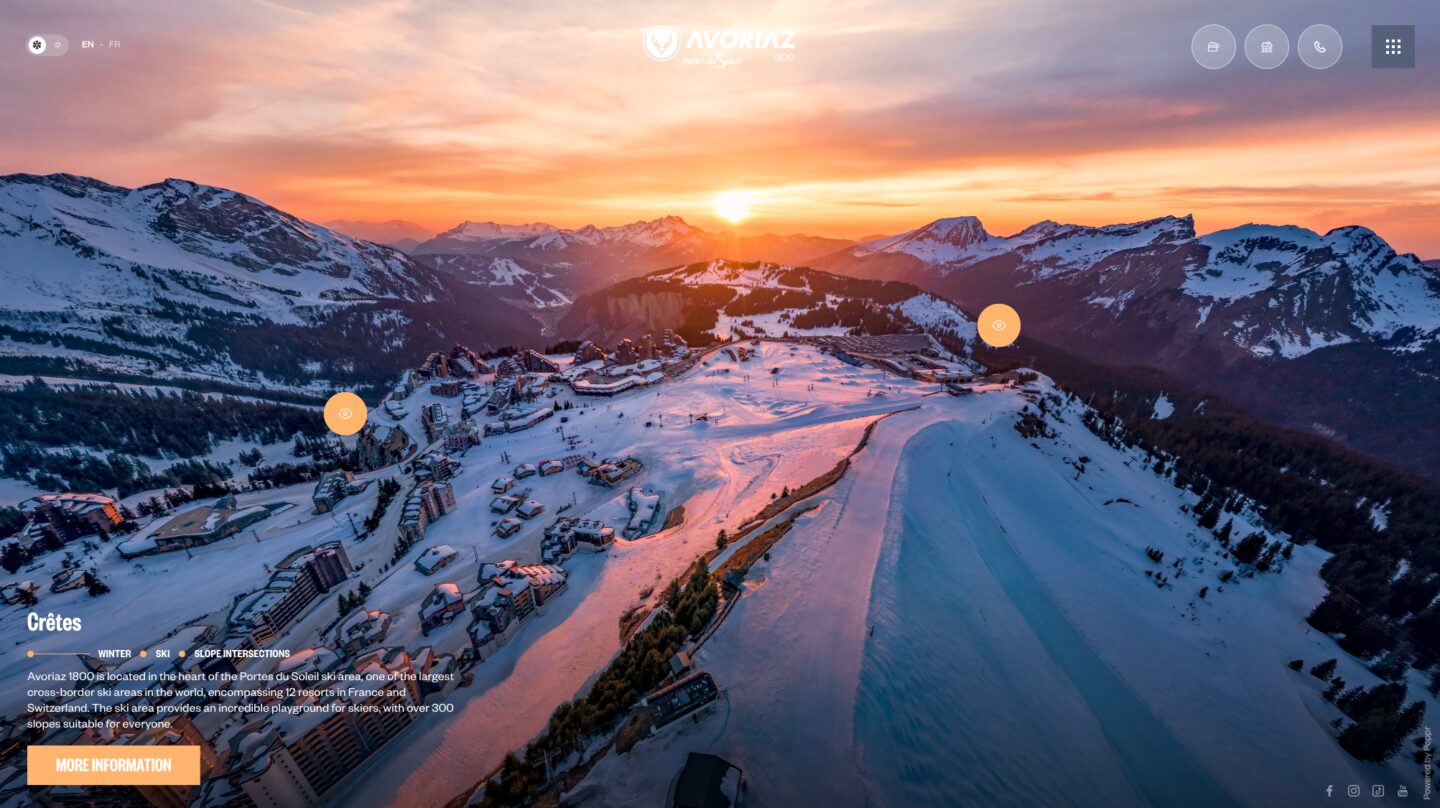
Avoriaz, a car-free ski resort in the French Alps, used Poppr's virtual tour to answer arrival questions, reduce uncertainty, and run an interactive campaign that attracted 43,000 new visitors.
The numbers behind the engagement
Across all 28 Center Parcs parks in Europe, Poppr's virtual tours produced consistent, measurable results:
- +311% longer average session duration
- +56.8% higher conversion rate
- +34.8% higher average booking value
- +194% more pages viewed per session
- Guests making booking decisions 36% faster
- Average revenue per booking up 25%
Virtual tours are a regional showcase, not just a single attraction
One of the most underused strengths of virtual tours for tourism boards is their ability to communicate regional breadth. A single campaign can cover a coastline and a city, a mountain pass and a market town, a heritage site and a contemporary arts district — all within one cohesive, navigable experience.
This matters because travel decisions are rarely about one attraction. People book destinations. They want to know whether there is enough to fill a week, whether it works for different members of a group, whether there is something to discover beyond the obvious landmarks.
A well-designed regional virtual tour becomes a discovery platform. Visitors stumble upon villages they had never heard of. They find the quiet cove three kilometers from the main beach. They see the hiking trail that connects the valley to the plateau. These are the moments of genuine surprise that convert a casual browser into someone with a booking intention.
Poppr's work on Virtual Bruges and Virtual Mechelen demonstrate this at the city level — complete digital twins that allow international visitors to navigate an entire urban destination before arriving.
Reaching the audiences that matter most
International visitors face a higher barrier to booking than domestic travelers. The journey is longer, the cost is greater, and the stakes feel higher. A virtual tour dramatically reduces the uncertainty that holds international visitors back. Seeing exactly what a destination looks like — its scale, its atmosphere, its practical logistics — replaces doubt with confidence.
Younger travelers and Gen Z have a documented preference for digital transparency before commitment. They expect an explorable, honest preview before they invest. For this demographic, a virtual tour is not a novelty. It is a baseline expectation. Destinations that offer it signal credibility. Those that do not are easier to skip.
There is also a growing, less discussed audience: travelers who experience anxiety, sensory sensitivity, or social stress in unfamiliar environments. Virtual tours allow these visitors to prepare mentally, map routes, understand the layout, and arrive with confidence. This is an inclusivity dimension that most destination marketing overlooks — and it represents a significant, underserved audience.
For more on how VR and immersive experiences are reshaping travel behavior, read: Digital discoveries: how VR is reshaping the travel industry
A long-term asset, not a campaign
Most destination marketing spend is ephemeral. A paid social campaign runs for six weeks and stops. A press trip generates coverage that fades. An influencer post has a half-life measured in days.
A virtual tour works differently. Once built, it is permanently embedded on your destination website, performing every time a visitor arrives. It improves SEO by increasing session duration and reducing bounce rate — both signals Google uses to determine search ranking. Most tours remain accurate and visually effective for 10 to 15 years.
The cost-per-impression over the lifetime of a virtual tour is lower than almost any other destination marketing investment. And unlike paid media, it does not stop working the moment the budget runs out.
For tourism boards under pressure to demonstrate ROI to city councils, regional governments, and tourism stakeholders, this long-term performance data is a powerful argument.
What a tourism board virtual tour should cover
- Key entry points and arrival experiences
- Signature attractions with full navigability
- Supporting neighborhoods and hidden corners
- Practical information embedded as hotspots
- Multi-season representation
Key takeaway
Tourism boards across Europe are shifting from static destination marketing to immersive virtual experiences that let travelers explore destinations before booking. Virtual tours reduce booking friction, extend session duration, and provide measurable engagement data that traditional marketing channels cannot match.
Getting started
A regional virtual tour is not a single deliverable. It is a strategic decision about how your destination wants to present itself to the world. The best place to begin is a conversation about which aspects of your destination are hardest to communicate through static content, and which visitor questions you most want to answer before anyone arrives.
Poppr has built virtual tours for ski resorts, holiday parks, historic cities, museums, and cultural landmarks across Europe. Every project starts with the same question: what do we want visitors to feel before they arrive?