
The future of culture: why museums and galleries can no longer afford to stay still
- Web experiences
- Virtual reality
- 360° Photography
- 3D
Virtual tours are transforming how museums, galleries, and heritage sites reach global audiences. From the largest Jan van Eyck exhibition in history to a 3D museum built without walls, Poppr shows what's possible when immersive technology meets serious cultural ambition.
The building is not the experience
For decades, cultural institutions operated on a simple premise: come to us. The architecture is the invitation. The collection is the reward. That worked when there was no alternative. Today, audiences are global, attention is fragmented, and the institutions that are growing their reach are the ones that have stopped treating their digital presence as a brochure and started treating it as a destination in its own right.
A well-crafted immersive experience can do something the building itself cannot: reach a researcher in São Paulo, a school group in Seoul, or a family in Manchester who has not booked a trip yet, and give them a reason to. That is not a replacement for the physical visit. It is what brings people to the door.
When the doors had to close
In February 2020, MSK Ghent opened the largest Jan van Eyck exhibition in history. Nearly 130,000 visitors came closer to Van Eyck than had ever been possible, standing in front of over 120 masterpieces, including the restored outer panels of The Adoration of the Mystic Lamb, united with other Van Eyck works for the very first time.
Then, six weeks in, COVID-19 forced the museum to close. Visit Flanders and MSK turned to Poppr. What followed was a full reconstruction of the exhibition online, at a quality that matched the ambition of the show itself.
Poppr built:
- 13 gallery rooms, fully navigable in 360°
- 120+ masterpieces, each viewable in high resolution with detail impossible through museum glass
- Audio guides and wall texts in 8 languages
- Full accessibility on any device, with no app or plugin required
The exhibition the world almost missed became one of the most visited virtual museum experiences in Europe, and it kept drawing visitors, researchers, and school groups long after the paintings had returned to their home collections.
What immersive actually means
The word "virtual tour" has been diluted. A slideshow with a pan effect is not immersive. A clunky plugin that renders poorly on mobile is not either. At Poppr, immersive means something specific:
- 20K resolution 360° imagery, manually stitched and cleaned in post-production
- Guided storytelling that moves at the viewer's pace, not a predetermined script
- Hotspots and context layers that reward curiosity rather than punishing it
- Native web delivery with no headset, no download, no friction
When the city of Mechelen commissioned Poppr for the 500th anniversary of St. Rumbold's Tower, the team captured the cathedral from over 3,900 angles, built a precise 3D model using photogrammetry, and used a 17th-century architectural drawing to reconstruct the unfinished spire in augmented reality, viewable from any smartphone. Visitors could scroll through five centuries of history in forty seconds, or linger for hours. The experience was used to educate, to inspire, and to bring a building's full story to people who had never set foot in Mechelen. On the role of photogrammetry in this kind of work, this article goes deeper into how 3D models are built from photography.
A museum without walls
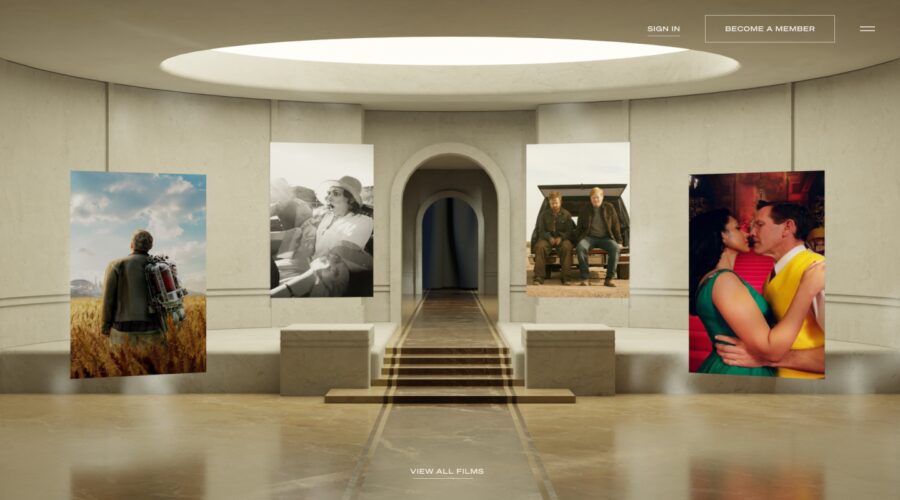
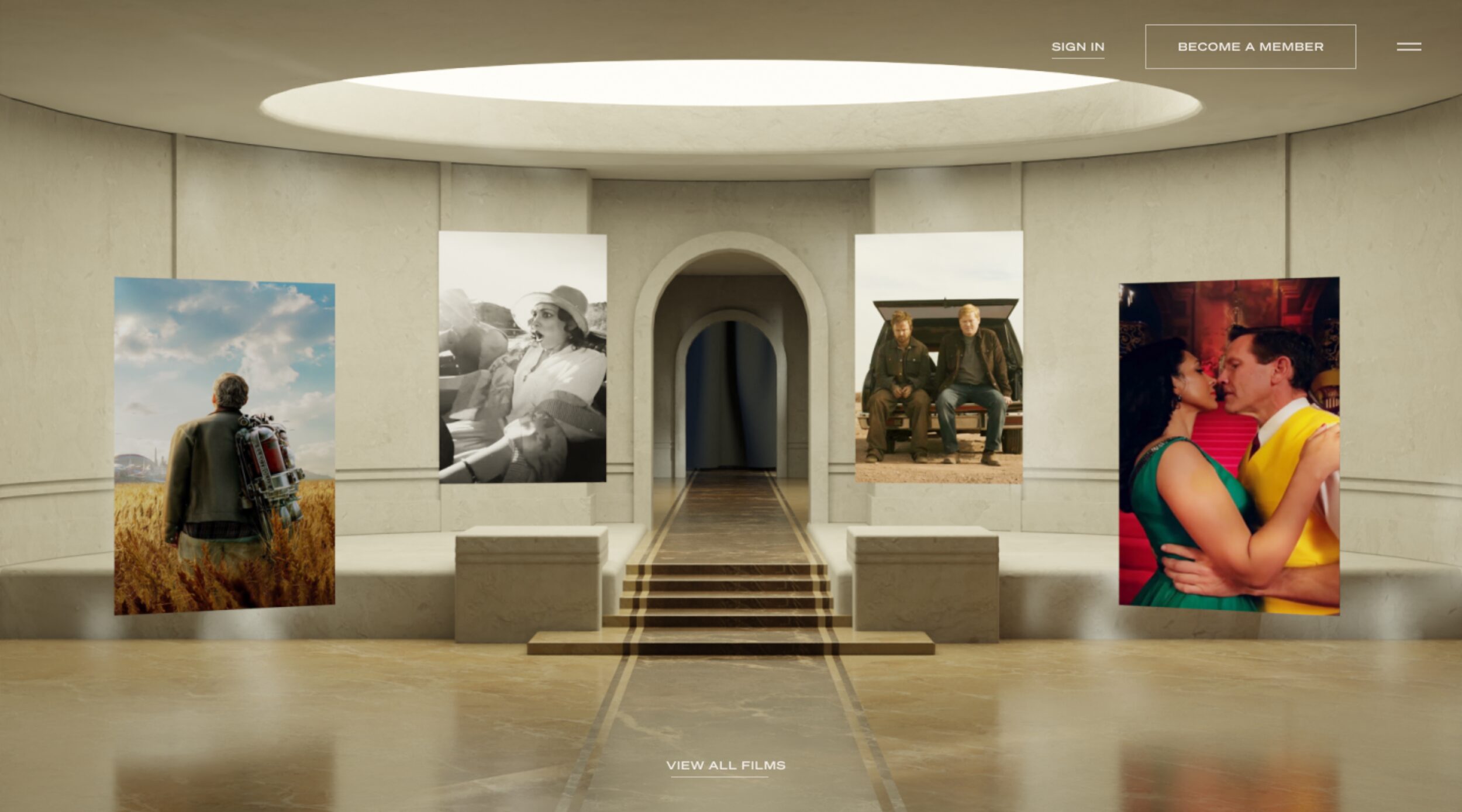
Not every cultural institution has a building to put on tour. Film Secession, an independent platform dedicated to cinema history, faced exactly that challenge. There were no galleries to photograph. The collection was ideas: films, archived interviews, critical essays, and connections between filmmakers across decades and continents.
Poppr built a 3D museum without walls. A fully navigable space where visitors move between filmmakers, eras, and art forms as naturally as they might wander through a physical gallery. The platform was built entirely to spec, with no SaaS platform compromises, and curatorial logic baked into the navigation so that connections surface organically as visitors explore. No venue. No opening hours. No capacity limit.
It demonstrates something important for cultural institutions of all kinds: the same thinking that brings a historic cathedral or a world-class exhibition online can also build something that has never existed physically. Travelling exhibitions, temporary collections, digital archives and institutions without a permanent home of their own are all within scope.
The case for permanence
Cultural institutions are often cautious about ROI, and that caution is understandable. A well-built virtual experience addresses it directly, because it is not a one-off campaign asset. It is a permanent part of an institution's digital presence. Consider what it delivers:
- Year-round engagement, independent of opening hours, seasons, or capacity limits
- Global reach with multilingual support from day one, as the Van Eyck tour demonstrated across 8 languages
- Educational partnerships with schools and universities that cannot travel
- Accessibility for visitors with mobility constraints, a consistently underserved audience
- Actionable data through Poppr's built-in analytics and CRM integration, so institutions know who visits, where from, and what engages them most
That data shapes future exhibitions, guides collection decisions, and gives development teams something concrete to show to funders. The Van Eyck tour did not go offline when the physical exhibition closed. It continued working. That is the difference between a digital experience built for a moment and one built to last.
The question is not whether to do it
The question is whether to do it well. There are cheap ways to put a 360° camera in a gallery and call it a virtual tour. There are also ways to build something that makes a person feel, for a moment, that they are standing inside a story: that the past is close enough to touch, that the art is looking back at them.
Cultural institutions have always understood the difference between a reproduction and an original. The same distinction applies to immersive experiences. The institutions that will define cultural engagement over the next decade are already thinking about this. They are not asking whether their audiences are online. They are asking how to meet them there with something worth staying for.