
Virtual tours for hotel groups and holiday parks: from pilot to rollout
- Immersive Websites
- Virtual Tours
How do you scale a virtual tour from one property to an entire portfolio? A practical plan for a measurable pilot, relevant booking links and manageable content, with Center Parcs as a real example.
One compelling tour. A whole portfolio that learns.
A guest is weighing up two room types. A family wants to understand the layout of a holiday cottage. An event planner needs to picture a meeting space. A virtual tour makes those decisions more tangible: visitors explore, compare spaces and find their next step.
For a hotel group or holiday park operator, there is another question: how do you deliver that quality across every property without starting again each time?
Our advice: begin with a clearly scoped pilot, but design the foundation for multiple locations from the outset. Test the guest experience, the booking journey and everyday content management before investing in a wider rollout.
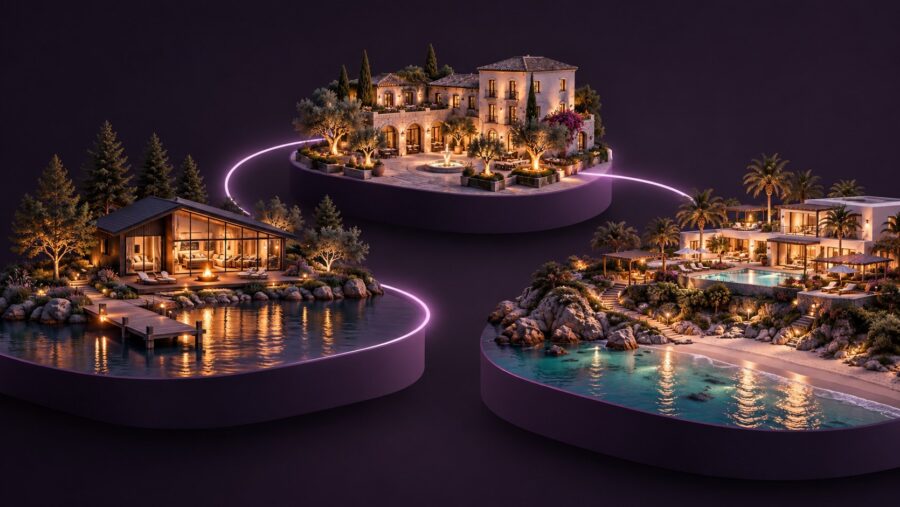
Hero image: a conceptual illustration of connected destinations, not actual client properties.
1. Start with the decision your guest needs to make
“We want a virtual tour” is a starting point. A useful brief goes further: what uncertainty is holding the visitor back, and what should they be able to do after exploring?
- Hotel rooms: understand the difference between a standard room and a suite, then check availability.
- Holiday accommodation: explore bedrooms, living space and the terrace, then choose the right accommodation type.
- Meetings and events: view a room in different configurations, then make a specific enquiry.
Choose one primary task for the pilot. Then define the scenes, information points and calls to action it needs. The guest’s question should determine production, rather than a target number of panoramas.
2. Choose properties that put the rollout to the test
Your most photogenic hotel is not automatically the best pilot property. Choose somewhere with a clear guest question, enough relevant website traffic and a team that can review the content.
If the size of the portfolio warrants it, include a different situation: another language, a more complex accommodation type or a different booking engine. This reveals early what can be shared and what needs local variation.
For each pilot property, record the audience, priority spaces, languages, booking destination and content owner. Account for renovations and available photography dates. A strong pilot is small enough to manage and varied enough to teach you something useful.
3. Create a shared foundation with room for local character
Guests should recognise your brand. Local teams should be able to present their property accurately. Both are possible when responsibilities are clear.
- Central team: visual identity, navigation, room-type naming, measurement definitions and quality checks.
- Each property: its own panoramas, amenities, practical information, languages and relevant booking links.
- Shared decisions: who can make changes, who approves them and when new photography is needed.
Test an everyday task, too: can the nominated team member update a description or link using the agreed CMS permissions? A polished tour that needs extra coordination for every small change is not yet ready to scale.
4. Open the right scene at the moment of decision
A general tour button on the homepage is a start. A useful opportunity often sits deeper in the website, where someone is actively making a choice.
- Let “Explore this suite in 360°” on a room page open that suite directly.
- Add a relevant entry point beside information about the pool or restaurant.
- Use the tour’s call to action to return to the matching accommodation, availability or enquiry page.
Check the entire journey on a phone. Are the buttons readable? Can visitors find their way back? Does the standard booking route remain available to guests who skip the tour?
A targeted link to the existing booking engine may be sufficient. Showing live availability, carrying selected options into a booking or connecting other systems requires separate technical scoping. Agree that distinction before production starts.
5. Measure booking behaviour and your team’s workload
Define success before publishing. Use a short scorecard that answers four questions:
- Use: how many visitors open the tour relative to visits to pages where it is available?
- Next step: how many relevant booking clicks or enquiries follow? Report counts and rates with a clearly stated denominator.
- Outcome: can completed bookings and booking value be measured reliably with the available integration and consent?
- Management: how much time do reviews, updates and publishing take for each property?
Compare relevant periods, traffic sources and devices. People who choose to open a tour may already be more interested. A higher conversion rate in that group does not automatically prove that the tour generated additional bookings. Where feasible, use a properly designed A/B test and agree the amount of data needed in advance.
Poppr’s virtual tour heatmaps can add insight into which parts of a panorama visitors bring into view. Use those signals to improve navigation and information, then test the effect.
6. Turn the pilot into a repeatable publishing process
Expand once the experience works, measurement is useful and the team can manage the content. Create the same publishing package for every new property: approved imagery, room-type names, translations, booking links, a content owner and a review date.
Group locations into manageable production rounds. Account for occupancy, weather, renovations and room preparation. Check each launch on mobile, in the relevant languages and with working calls to action.
Budget for life after launch. Separate photography, design and setup from hosting, support, content updates and new shoots. Agree usage rights, access and handover arrangements. An attractive starting price means little without a clear view of total costs and management effort.
Center Parcs: a shared platform for 28 holiday parks
For Center Parcs, Poppr developed a virtual tour programme covering 28 holiday parks. Accommodation, facilities and activities sit within a shared framework, with consistent navigation and links towards booking.
The partnership began in 2015. The case shows why a maintainable platform matters: properties change, spaces are renovated and information needs to keep up. A common foundation allows targeted updates while each destination retains its character.
For a new hotel group, we define the scope, integrations and measurement goals around that organisation. The existing programme demonstrates experience across multiple locations; your business case starts with your own circumstances.

Villages Nature Paris in the Poppr virtual tour for Center Parcs.
Frequently asked questions about a portfolio rollout
Do we need to photograph every hotel room?
No. Start with representative room types and meaningful differences in layout, views or amenities. Be clear about what guests are seeing so that one example room does not become a promise about every room.
Can a virtual tour work with our existing booking engine?
Linking to the relevant booking page is often possible. Deeper integration depends on the capabilities and access offered by your booking system. We investigate that during scoping.
When is a pilot ready for a wider rollout?
When the agreed guest journey works, the evidence is sufficient and production and management costs make sense for the next properties. A fixed calendar date alone is not a sound decision rule.
Which properties are your best starting point?
Tell us which hotels or holiday parks you manage, what guests currently need help understanding and how your booking journey works. We will discuss a defined pilot with clear content, costs, measurement and a possible next stage.
For more about our approach, explore how we build a custom virtual tour.